
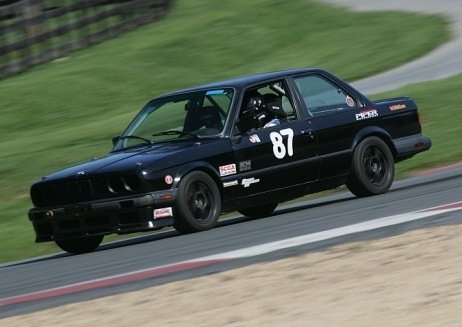
 Over the last 3 years, I converted a 1987 BMW 325is from a beater that was barely drivable on the street into a dependable track car. This car isn’t pretty, but the BMW E30 chassis is sturdy, the M20 engine is tough, and parts are relatively cheap. It’s a great starter car and very fun to drive. After many track events, it was time to step up to competitive driving and get my racing license.
My original goal was to take two SCCA racing schools in the spring and then run the Mid-Atlantic Road Racing Series (MARRS) in the E Production class. (This would be a phenomenally slow E Prod car but the goal was to race — not necessarily to win.) I spent the late fall and entire winter making the car legal for racing.
To get one’s license with SCCA, two driver schools are required. In my area, these are generally held in the early spring. Between finishing the car, testing it, and “teething” problems, it was early summer before I was ready to go. The SCCA schools were done and I missed them.
So, I decided the NASA GTS class was a good alternative; NASA puts on intense one-day schools throughout the year prior to a normal race weekend. I signed up for the NASA Super Comp school-and-race weekend at Virginia International Raceway in July. VIR is a wonderful track with good elevation changes and some very fast turns. I’d driven it before so I didn’t have to worry about learning a new layout.
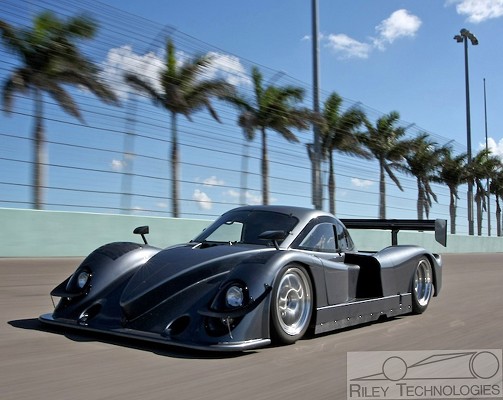 After a five-hour haul from Maryland, I arrived at the track on a warm Thursday night. Lucky me! I happened to set up in the paddock next to the Riley Technologies team and their 600 horsepower track day car, a beautiful streamlined missile of amazing speed and agility. In addition to this wonderful car, the team brought winning professional driver Marc Goossens to compete in Friday’s Ultimate Track Car Challenge, an event that draws all kinds of interesting cars and teams to compete for fastest lap times and bragging rights.
After we discussed the fine art of auto racing, Marc asked if I’d take his place on Friday for the UTCC event. I told him I couldn’t because I was enrolled in comp school… OK, things didn’t quite happen that way. I never met Marc (but I did see him look longingly at my car) and, although I spoke to the crew, no one asked me to run their V8-powered Riley in the UTCC. Not even during practice. I was puzzled by that.
Back to reality. The school was really good. But they weren’t kidding when they said it would be a full day. I was absolutely whipped by the end of it. Half of my fatigue was due to things I didn’t plan for: the nerve-wracking way my hood behaved out on the straights, the oil leak, the difficulty in getting a window net up after buckling myself in… things like that. The other half came from learning to run three wide all the way around the track, practicing leap-frog passes, alternating lines, and trying to keep the speed up without hitting anyone. It was hectic.
Regarding the hood problem, it went something like this: As the car approached 180 MPH on the back straight — or was it 80? — the hood would float on the pins and then kink at the corners. I thought I had already fixed this problem after some shakedown runs at Summit a month before. There, I noticed that the hood bowed in the center at high speed. The car looked like a blue whale eating krill. I welded a length of half-inch square tubing across the nose of the hood and tightened the fit of the pins. That fixed the problem — at Summit Point.
At VIR, where the speeds are much higher, the wind simply went to work on the next-weakest area of the hood. To make matters worse, the front pins were loosening throughout the weekend. I was in a rush when I mounted them and had no prior experience, so that makes me a moron. Anyway, the hood tried to flip up at the corners on either side of the brace, making the car look like one of those cute cats with the tiny ears. During every lap, I expected the hood to fly into the sky like a roof shingle in an Arkansas tornado. The sheet metal was looking worse after each session and the pin mounts were starting to let go. Luckily, I brought the rivet kit with me.
So I’m going from track to classroom to track without a break all day, and there’s no one to work on the car while it sits. I really didn’t need this crap.
To add to the stress, the entire left side of my motor was soaked with oil and I couldn’t figure out where the hell it was coming from. I had to dump a quart of Redline in after every session. The guys who sold racing supplies ran out of fifty-weight and were talking about setting up a pipeline to the refinery.
I had a pounding headache by the end of the day. After the instructors deliberated (for an eternity) over which students would be allowed to race, I was granted a provisional competition license. Yay! I was so excited that I went straight back to the hotel and went to bed.
The next day, I had Phil replace my trashed Toyo tires with a set of Hoosier R6’s. Phil rocks and so does his wife; they provide on-track service to racers up and down the East Coast and are passionate about racing. So, I was ready to race. I think I missed the first practice (waiting for tires and trying to remedy the hood), but I was OK with that.
Somewhere between Friday and Saturday, an angel descended from heaven by the name of Roy Armstrong. Funny name for an angel, I thought, but I didn’t want to bring it up lest I invoke the wrath of The Racing Gods. Roy runs an H Prod Datsun 510 with SCCA but he happened to be at the track that weekend with a Mini in support of his wife and her first DE. He wandered over from time to time and asked if he could help. By the end of the weekend, he had taken on multiple roles including crew member, master fabricator, driving coach, mentor, and All Around Good Guy. I don’t think I could have done it without him.
I went out Saturday and qualified way back, trying to get a feel for the new rubber. The intent was to break the tires in gently but that idea went out the window like a gum wrapper after the second turn. There were cars everywhere and I was having a blast. I even passed a few. OK, they were usually limping to the pits or sitting by the side of the track in flames, but a pass is a pass.
After the session, I felt very privileged to finally join the guys who gather in front of the time sheets. I flagged SCCA for a few years and always wondered when I’d join those ranks. Wow! There’s my name… way down at the bottom. I’m a racer! Life was indeed fine.
Later that day, a dark storm began to brew on the horizon. Not the real horizon, but the one that has a BMW logo on it. My car was showing signs of imminent failure. Coming out of the famed Oak Tree corner in third gear, I felt the engine rev as if I was getting some wheel spin. Or the cheapo 4.10 differential I scored on eBay was letting go. Or (gulp) my brand new ClutchMasters Stage V clutch was slipping.
I drove the car gingerly for the rest of the session and returned to the paddock. When I used the term “wheel spin” in front of my so-called “friends” in the paddock, they all busted out laughing.
“Buddy,” they cackled, “You’re not getting wheel spin from 145 horsepower in third gear. Not in this car.”
Fine, whatever. I had to agree. It was probably the clutch.
Time to line up for the Saturday race. Oh. My. God. This is it! Roy had already scouted the grid and told me that the top cars were positioned under the canopy. If you’ve seen the grid at VIR, you know that there is a finite number of spaces available for cars to line up side by side under a large canopy. Any cars not qualifying high enough have to sit in the open and wait for the pace lap.
I’d never gridded before so I was nervous. Roy said he’d meet me up there. The first grid worker checked my number as I approached and looked me up on his sheet. I could see cars baking in the sun outside of the canopy. The worker looked quizzically at his sheet and then back at my car. He approached the window and shouted out a grid position — a numbered position under the canopy!
“Pull up ahead,” he said. “The next worker will tell you where to go.”
I pulled up past the other cars along the line next to the canopy. I found the last open space and the worker there centered me in the lane. I was in a nice shady spot next to an impressive looking BMW several years newer than mine.
“Oh shit,” I thought. “This is wrong. They made a mistake. What the hell am I doing here? That car next to me looks like it can do 700 miles an hour. That’s Scott Pruett inside! Or is it Bill Auberlen? I’m doomed!”
Roy ducked his head in through the passenger window. “How ya doin’, buddy? Ready to go?” He walked around and opened the door, cinched my belts, knelt down beside me.
“Roy, why am I here?!”
He laughed and walked over to the grid worker standing near my car. Next thing I see, they’re laughing and joking around, relaxed as can be on a hot and breezy summer day in southern Virginia. When he came back, he said he didn’t know why I was here but whatever just get ready to race.
As it turned out, I was the only GTS2 car in the field. That meant I got lumped in with the Spec3 and GTS3 cars in the first wave of a split start. Second wave was Spec E30’s, 944’s, and whatever else they had back there. It didn’t matter that I qualified near the bottom of a 54 car field. I was going off in the first wave with the faster cars. I briefly considered jumping out of the car and running off into the woods.
After an interminable wait, we rolled onto the track, formed up behind the pace car, and proceeded around the track. When the green fell, I was beaming from ear to ear. Noise! Dust! The smell of rubber and brake pads! Chaos and confusion! We dove into T1 with what seemed like millimeters between us. This is what I lived for. This is what I loved so much about racing. And this time I’m out here doing it!
The race was clean. I stuck with one of the Spec3 cars for a while (another rookie — I could tell by the orange plate) but he eventually slipped away. Some time later, the sharp end of the Spec E30 field passed me. I found some more rookies and backmarkers to dice it up with. It would have been fun, but…
The slippage was getting worse, lap by lap. Eventually, I had to feather the throttle in second and third when exiting turns and I even had to lift when the revs got high in fourth. I simply couldn’t launch out of the corners any more. Speed was gone and I couldn’t really compete with anyone – even the other rookies slipped away from me. Dammit.
I was elated to finish and glad that I kept it clean, but the excitement soon morphed into dejection. Something was wrong with the clutch and I had a pretty good idea what it was: oil. All that oil coming from the breather pipe was slowly seeping into the bell housing and fouling the friction surfaces of the flywheel and clutch. I considered pulling the plug on the weekend so I could go fix the car. Why run Sunday? What if the clutch blows completely and takes my new aluminum flywheel with it? I should just pack up and go.
That’s when Roy offered some sage advice.
“You need to get through this. You’re here to complete your novice requirement. The goal is to get that race director’s signature in your log book. Just nurse the clutch, shift slow and clean to keep it cool, and make it to the finish line. Stay out of everyone’s way and do the best you can.”
Roy saw the big picture. He had some racing savvy. I was glad to have him around. Instead of being put off by every little problem, he had a can-do attitude. If we can fix it, we will. If we can’t, we’ll work around it. Stop crying, wipe off that mascara, smooth out your wrinkled dress, and get back to it.
Sunday brought more of the same but with one major Code Brown moment that I’ll never forget. It wasn’t a high-speed incident or a wreck. It was just, well.. intense. I started in the first wave again and, after one lousy lap, was clipping along through the Climbing Esses by myself. I checked my mirrors and saw the sharp end of the Spec E30 field coming on fast. Chris Cobetto and friends. “Uh oh,” I thought. “The timing might not be real good here…”
As we crested the rise into Oak Tree, a shit-storm of snarling M20 engines were all over me. It happened in the blink of an eye. Contrary to popular notion, I got off the line early and stayed inside so the leaders could get a fast exit onto the back straight. But the turn feeds into a bottle neck with a gigantic tree on the inside. Oh God! In those split seconds amid the bumper-to-bumper noise and smoke, I saw the corner worker’s eyebrows raise. He stepped back and I think he seriously considered climbing the tree.
I seriously considered screaming like a girl.
But I was a racer! And racers don’t quit. I looked straight into the turn and saw nothing but a wall of galvanized German steel between me and the apex. These guys are bumper to bumper and they’re not messing around. It was an act of faith to simply drive the car forward. I clipped the kerb, avoided the inside wall, gingerly got back on the gas, and blended into traffic.
Wow! No contact. No “F.U.” flags flying from the middle fingers of other drivers. They were gone and I was cruising down the vast back straight, feathering the throttle to save my clutch and pointing the mid-pack guys by.
I made it! If I can keep this clutch alive, I’m home free!
I took the checkered flag without further incident. The car was slow but I never held anyone up or created a hazard. Passing etiquette learned in non-competitive driving events was well applied here. When I exited the pit lane into the paddock, Roy was standing off to the side. A bottle of cold water landed in my lap. What a guy. After I got out of the car, he ran up and shook my hand. I didn’t quite understand why he was so excited.
“I am proud of you. I drove up to Oak Tree to watch the race. You handled that situation perfectly! You got off the line but you didn’t back out of it. You went through the corner without getting in anyone’s way. Man, I gotta tell ya, I saw those guys coming and was thinking, oh shit! This could be bad! But you did it. I’m really proud of you!”
That felt good. Roy was genuinely pleased with my performance. I felt like Kerri Strug sticking the landing with a busted ankle… except I didn’t win an Olympic medal or anything quite so dramatic. Yet I somehow earned a stripe out of that mess.
At the end of the day, I took my logbook to the race director and got my signoff. All I needed was two more races to complete my rookie requirement. I got those some time later at a very wet, very cold race track in New Jersey.
That’s another story.
 Another Time