
It was the snowiest winter on record in Washington D.C. and I was restless. The familial holiday glow from my Christmas visit to Minnesota had faded and the Vikings lost the NFC Championship game. Summer shimmered in the distance, out of reach. I decided to head south to warm my bones, relax, and maybe find some adventure.
Without too much thought, I settled on Key West as my destination. A quirky island, Key West is known for Ernest Hemingway, party bars, gay-friendliness, and wandering chickens. I’d seen many of the sights during a previous visit, so this time I wanted to try some new things.
There was only one hitch: I wasn’t a certified diver and I didn’t have time to get trained before the trip. But the world always finds a way for tourists to spend their money and I soon discovered the introductory “resort course”. A resort course is a one-day introduction to scuba diving that would take me from the classroom to the pool to the ocean in one day. I searched the Internet and picked a dive shop that had several positive reviews: Dive Key West. One quick phone call, and I was signed up.
As a boy, I watched The Undersea World of Jacques Cousteau on TV with my dad. The divers swam effortlessly over vast ocean landscapes in a silence punctuated only by the sound of exhaled bubbles. By simply donning tanks of air and falling backward off a boat, they could escape Earth’s gravity and fly free like astronauts.
The reality of my first open water dive was somewhat less tranquil.
I walked into Dive Key West on a cool Thursday morning in early March and was greeted at the counter by a brown-haired girl who wore shorts, a light blue polo, and flip flops. She looked like she was about seventeen. At first, I thought she was just going to handle the paperwork.
“Hi, I’m here for the resort course.”
“You must be Scott. I’m Lana. I’ll be your instructor today.”
Lana had the relaxed confidence of someone who had introduced many people to the wonders of diving and the sea. Her voice reminded me of Drew Barrymore; friendly and relaxed.
We talked briefly about how the day would progress: a short overview in the classroom, learning the basics in a swimming pool, then — weather permitting — an open water dive on the reefs to the south. I watched the mandatory safety video, chuckling at the warning against using drugs when diving (a coffee table with a joint, a cocktail, and pills on it). Then Lana taught me about the hand signals used to communicate under water: “watch me”, “OK”, “not OK”, “ascend” and “descend”, “look”, and “repeat”. She saved the most sobering signal for last, making a slicing motion across her throat that meant, “I’m out of air.”
We then loaded heavy steel tanks and mesh bags filled with gear into the truck and drove to a nearby hotel for basic training. The weather was unusually chill but the water in the pool was warm. We changed into swimsuits and Lana prepared for the water.
“Let’s do this the easy way,” she said.
Lana took one of the tanks and, with the buoyancy vest and regulator attached, lowered it into the pool. Then I jumped in and she steadied the tank while I wiggled into the straps. Buckled up, ready to go.
Standing in the shallow end of the pool, Lana went over some fundamentals like retrieving and clearing my regulator, and clearing a flooded mask. Then we swam to the deep end where I learned how to control my buoyancy by pressing buttons on the inflator hose that hung off my left shoulder. White to go down, red to go up.
“OK, you’re doing fine. Just swim around now and get used to it.”
As I moved about in the deep end, Lana hovered nearby swimming gently at times or just sitting quietly on the bottom. The weight of the tank on my back was heavier than I expected but the partially inflated vest seemed to keep it balanced. My breathing slowed as I began to relax in my new environment. Before long, it was time to go.
“You’re easy,” Lana said with a smile.
“Oh? Are some people not so easy?”
“We get all kinds. Some people are fussy or scared. Some people have trouble learning the basics. People like you make my day easier.”
I was glad I could make Lana’s day easier. I was having fun and, although I wasn’t taking anything for granted, I felt comfortable with everything I’d learned so far.
Back at the shop, Lana checked the condition reports and decided to postpone our open water dive. Too windy, she said, and it wouldn’t make for a good first experience. The sea was restless and wouldn’t have me, but my vacation was just getting started so there were other things to do.
Saturday, first thing, I called Dive Key West. A stiff breeze was blowing from the north and no dive boats had left the marina yet. They told me to check back. Later, air observers reported improved conditions on the reef to the south. Still, it wasn’t a sure thing; no boats had gone out yet. We decided to give it a shot.
We loaded up the truck and I hitched a ride to the marina with an experienced diver from Washington state named Julie. Julie worked for the US Navy and was in Key West for two weeks to train F-18 aviation maintenance technicians. (Nice job, if you can get it.) Julie was also a self-confessed dive junkie and was happy to be getting on the water. “I haven’t been for two weeks and it’s driving me crazy,” she said.
At the marina, we boarded the long white boat and met Captain Steve, who promised to do his best to find us good water. There were about ten people on board including scuba divers, snorkelers, and instructors. Greg was the dive master for the trip, a young bearded athletic guy with curly hair and a perenially happy face. Jacqui was tall and slender with blonde hair and beautiful Scandinavian features. I’d find out later that day that they were a very fun couple.
As the boat moved into open water and picked up speed, the mood on the boat became light and playful. Instructors and the more experienced divers joked around and laughed as we skipped across blue-green waves. The sea looked friendly and inviting. But the experienced divers saw things that I didn’t. The air was cool and the sun was bright as the strong boat powered ahead, farther and farther from land. Captain Steve was at the helm on the flying bridge and the instructors pointed out “blue lines” in the water where the water was calmer, deeper.
I was enjoying the ride but, at the same time, I was somewhat preoccupied with not getting seasick. I consider myself a boat person, and I love the water. But I’d never been out to sea on a small craft. Although I felt fine, I kept looking north toward the island to keep my bearings and equilibrium.
It was a long ride to the reef near Sand Key Light. The island of Key West was now a thin skyline on the horizon. Captain Steve cut the engines and maneuvered our boat toward a round yellow mooring buoy bobbing on the surface.
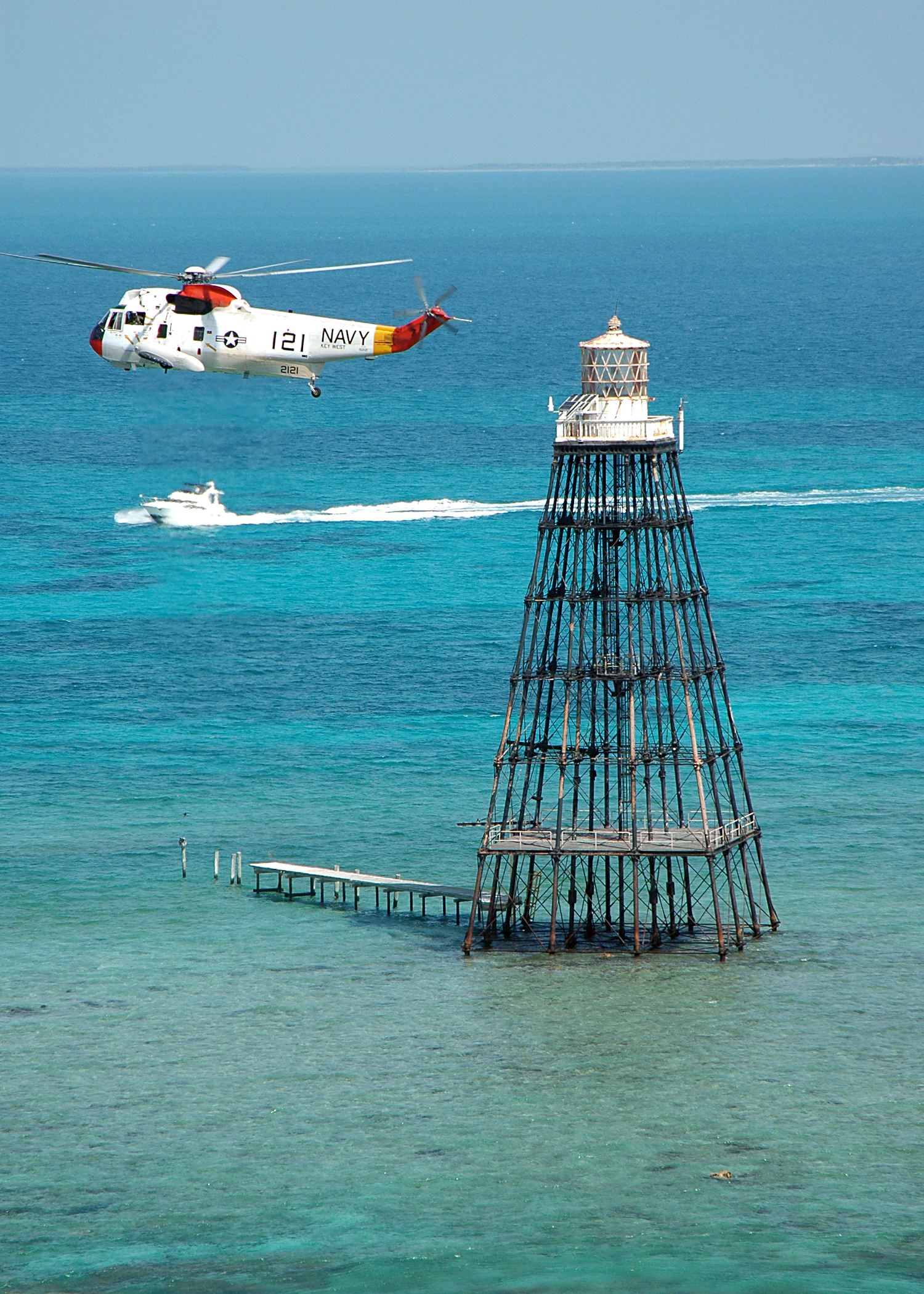 Sand Key Light sits between two channels that lead into Key West, about six nautical miles south of the Southernmost Hotel on Duval Street. The light and its tower are the only part of Sand Key that you can really see; the rest is just below the surface. It was not far from the light that we stopped and prepared to dive.
Now there was flurry of activity between the long white benches that ran along the sides of the boat. Divers were donning wet suits, fins, and masks; instructors were loading vests with lead weights and mating regulators to air tanks; deck hands were setting lines.
I put my wet suit on backward. Lana noticed. I laughed nervously and took it off, smelling the faint stale odor from the last person who used it. Then I slipped my feet into giant rubber fins, strapped the mask to my face, sat down in front of my tank, and wriggled into the shoulder straps of the buoyancy compensator. All the while, the boat heaved in the choppy waves.
Once everything was fastened, it was time to stand up and walk to the back of the boat. No tipping backward over the side, like Jacques Cousteau and his divers did on TV. That’s a technique for getting out of a boat that doesn’t have a walk-out platform. Standing up with an air tank on my back proved to be a challenge. I couldn’t even lean forward to begin the act of standing. Greg, the dive master for this trip, reached back and freed my tank from the large clip that held it to the side of the boat. Then he grabbed the tank and lifted as I stood up.
Standing on a boat in full diving gear, I began to understand what a fish must feel like when hauled out of its natural environment and on to a hard deck. I felt like a weighed a thousand pounds. I teetered as my legs strained to hold my top-heavy mass. I walked gingerly, clumsily to the back of the boat, Lana and Greg bracing me. Lana jumped in the water and turned to me.
“Just take the big step like they taught you,” Greg said.
But no one ever taught me the big step. I found out later there was a little bit of confusion about my experience level. Greg thought I was a student in pursuit of a diving certification. But I was a “resort”, and so only had an hour of pool experience. It didn’t matter now, though. It was time to get in the water. Lana shouted from the waves.
“Hold your mask with your hand and then take a big step off. Make sure you step far enough so that the tank doesn’t hit the platform.”
Still teetering under the weight of the tank, I stepped into the cold and overwhelming sea. Splashing down, I took a breath through the regulator in my mouth. I didn’t realize it at the time, but the water was cold. The first touch through my wet suit was a shock and I immediately began hyperventilating. I pulled the mouthpiece out and gasped at the sky. My lungs were pumping furiously and I couldn’t control them. Lana called to me and asked if I was OK. I couldn’t answer because I couldn’t talk. I gave her the “OK” sign but she kept asking. I don’t think she believed me, and rightfully so.
Soon my breathing slowed, my body dispersed the shock and compensated for the cold. The waves were chaotic, breaking over my head and making me cough. I looked to the sky, felt the sun on my face, and calmed myself. I put the regulator back in my mouth, bit down, and took a lungful of air. I looked at Lana and gave her the “OK” sign — for real this time.
I took hold of the tag line, a rope runs from the back of the boat to a brightly colored float 85 feet away. Twenty feet from the boat, a weighted rope hangs from the tag line and goes to the bottom. I swam along the tag line toward Lana, who was waiting for me.
“Follow me and hold onto the down line. It’s about fifteen feet deep here.”
With a turn and a flip, she was gone. I tried to follow but I couldn’t. I bent at the waist, put my head down, and tried to dive. Instead, I just flapped on the surface like a dying tuna. I pressed the white button to let all the air out of my BC, but I still couldn’t descend. I grabbed the down line and tried to pull myself down. I saw Lana coming back up from the murky green depths. I pulled and pulled until a shiny silver chunk of metal appeared in my hands. It was the weight at the end of the line.
“You need more weight,” Lana said. “Let’s go back to the boat.”
I pressed the red button to inflate my vest a little and swam clumsily back to the dive platform. Greg handed small gray slabs of metal down to Lana and she tucked them into the side pockets of my vest.
“There,” she said. “Let’s try that.”
We swam back to the down line and I gave Lana the OK signal. She disappeared beneath the waves again. I pressed the white button to deflate the vest, stuck my head beneath the surface, and drifted effortlessly downward.
My breathing was hurried and erratic, typical for a rookie. I couldn’t see but I knew I was descending. My eardrums flexed inward as if a vise was slowly closing on my head. I pinched the rubber nose seal of my mask and forced air into my sinuses and felt the satisfying pop of equalized pressure. As I continued down into the gloom, a faint claustrophobic fear gently embraced me.
Exhaled bubbles roared past my head. It was noisier than I imagined it would be. That was another aspect of diving that wasn’t conveyed by the Jacques Cousteau TV shows. Pops, clicks, squeals, and the periodic hiss and thunder of my regulator. The visibility was so bad I couldn’t tell if I was moving or not. White grains of sea dust floated all around me. I was in a noisy snow globe filled with dirty green mouthwash.
Then I saw the white sand bottom and Lana. I was glad because I didn’t want to go any deeper. The surface was life and I didn’t want to get too far from it. I clumsily stopped and wriggled into an upright position with my knees in the soft sand. I pressed the red button to put some air into my BC and floated free. Lana gave me the OK signal and I returned it. She turned and swam away slowly and gracefully.

I was still holding onto the rope and trying to get myself settled in this new world. But Lana was slipping away from me and I knew that I’d lose sight of her quickly. As I swam tentatively after her, I still had the down line in my hand. It was my last connection to the surface, to safety, to life. I remember not wanting to let go of Mom’s hand on the first day of school. The choice was to die pursuing Lana or die here alone with the line, so I let go and swam.
I swam closely above and behind Lana and knew what it felt like again to be an infant. I wouldn’t let her get more than a few feet from me. I would have attached myself like a remora if I could have. We came upon a large rope as thick as my forearm anchored to the bottom. It was the line holding the mooring buoy that the boat was tied to. Lana pointed to it enthusiastically as a tour guide would, happy to be seeing something — anything — in these poor conditions.
My breathing was slowing a bit and I focused on buoyancy and accurate swimming. The weight of the tank, the huge fins, the tendency to overuse the arms, all of these things get in the way of normal swimming. I tried to become more fish-like and rely on my “tail” to move me through the water. As we entered the shallower water around the coral, I struggled to stay above the bottom. Everyone knows you’re not supposed to touch the coral, but I couldn’t help laying a hand down to steady myself. Lana wagged her finger at me. I couldn’t tell her that I didn’t mean to. No matter how much I played with the buttons on the inflator hose, I just couldn’t seem to get it right. The swimming pool didn’t have waves.
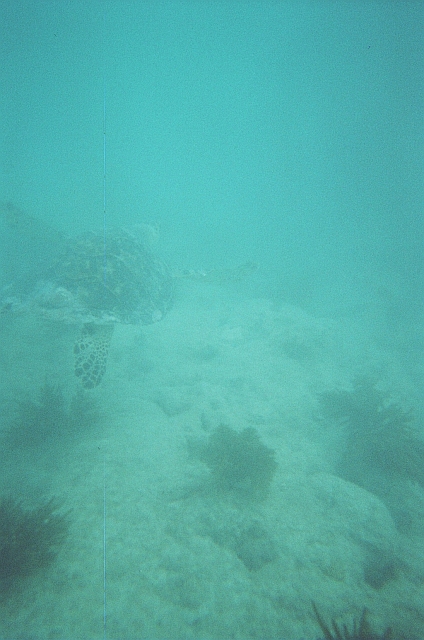 The sights were amazing, but between the murky water and my growing discomfort, they were difficult to enjoy. We saw a large spherical brain coral which seemed to draw me in like a magnet. I probably killed it by pushing off with my hand. A little further on, a sea turtle emerged from the mist and swam gracefully away. But he swam toward shallow water so we turned back.
We swam over the edge of a small ridge in the coral and then down, hugging the reef to our left. My mouth was getting very dry and I was still fighting the occasional surge of panic; I felt like ripping the regulator out so that I could breathe normally. Then I began to lose my equilibrium again. The wall of coral was disorienting my sense direction and I began to feel tired. Lana turned to me and checked my status with the OK sign. I decided it was time to stop. I didn’t want to go on and risk making a mistake because of fatigue. I gave Lana the “surface” signal and we ascended.
On the surface, the sun was bright and the waves where chaotic. The dive boat was about 50 yards away, tossing on the end of the mooring line. Lana asked if I was OK. I said I was just a little tired and ready for a break. Swimming back to the boat was difficult. Lana told me kick from a sitting position with my back to the boat. Everything Lana did was so relaxed; she didn’t seem to expend any effort. I consider myself to be in good shape, but this was new and I was struggling.
Lana pulled away from me, knowing that Greg was keeping an eye out from the bow. When I finally reached the dive platform, I was exhausted. Greg helped to lift my tank up as I climbed the aluminum ladder. It was such a relief to shed the mass of steel and rubber strapped to my torso, to take the mask off and the wet suit. I felt light as a feather but could only sit like a lump on the bench and hang on. I couldn’t stop yawning.
The only thing I wanted was to maintain equilibrium and not get sick. I was extremely sleepy now and yawning constantly. After the others were aboard, Captain Steve moved the boat down the reef and everyone readied themselves with a second dive. I told Lana that I just wanted to sit. It was hard to watch everyone having fun, but I didn’t feel like I could handle another dive. One of the other divers was the father of a boy who was completing his certification class. The father hadn’t done any diving for a few years and had already bailed out; he didn’t make it 20 feet from the boat before turning back. He joined me on the bow where I sat by myself, my eyes fixed on Sand Key Light, trying to evade nausea.
“It’s been a long time since I dove but I wanted to do it with my son,” he said. “But I don’t know, man. Maybe when we get older we just can’t do it any more. I felt so uncomfortable out there”.
“It’s pretty rough today,” I said.
He was a nice guy, but I really didn’t feel like talking. I was fixed on the steel light tower that rose from the water to the southwest. All I wanted to do was not puke. Soon everyone was back on board and we were heading for the harbor. As the boat picked up speed, the tossing stopped and the boat skimmed smoothly over the chop. The wooziness subsided; I was feeling better. I love the special thrill that speed brings, even more so when it eases a dizzy head. As my mood lightened, I thought of trying again.
I met Lana, Greg, and Jacqui at a bar just off Duval street that night. As we drank and relaxed, I began to tell Jacqui about the overwhelming feelings — mental and physical — that I experienced on the boat.
“It’s so cool to hear this,” she said. “We, as instructors, need to know what’s happening. We don’t get as much feedback as we’d like and we can’t improve the experience if students don’t tell us about theirs.”
Lana was sympathetic and encouraging.
“You need to come back,” she said. “The conditions were really bad today. You’re good at this. You picked up everything so easily. Come back in July; the water is fantastic in the summer.”
I promised I’d go back and try again someday. I know that the beautiful “Jacques Cousteau experience” is waiting for me, and I too can float weightless above a serene world of color and beauty. Maybe the sea will welcome me next time.
 Another Time